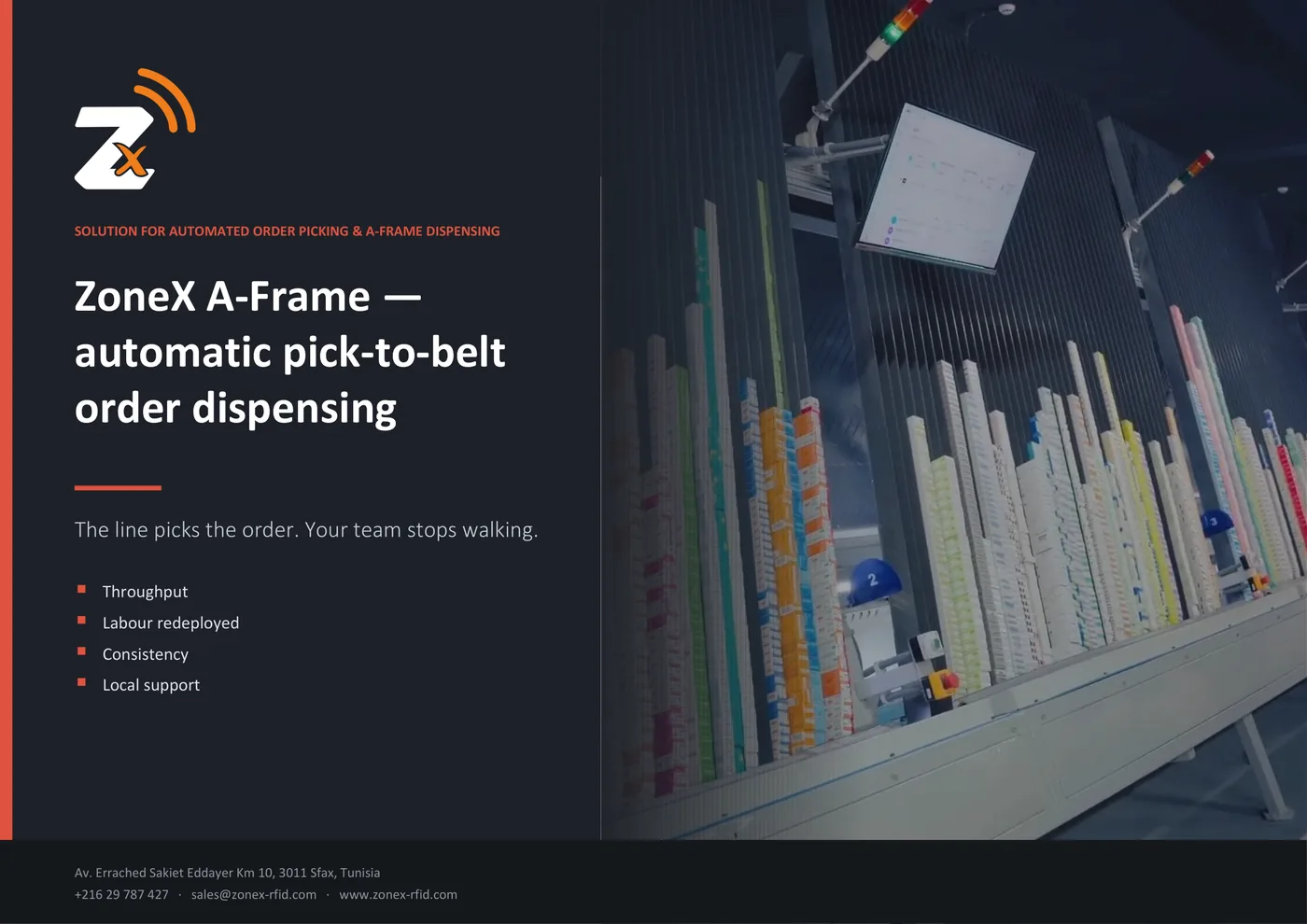
The line picks the order. Your team stops walking. The line picks the order. Your team stops walking, and starts replenishing.
The line picks the order. Your team stops walking, and starts replenishing.
Who this is for : Distribution and warehouse directors, order-fulfilment and operations managers, supply-chain directors in pharmacy, healthcare, cosmetics and fast-moving consumer distribution.
THE PROBLEM
In a high-volume, low-piece-count operation, most of the picker's day is travel between locations, not picking. You are paying for footsteps.
The only way to fulfil more orders before the delivery cut-off is more people on the floor — and at peak, those people do not exist.
A wrong box in a pharmacy delivery is not an inventory adjustment; it is a credit note, a phone call and a damaged relationship.
Everything is organised around getting the round out on time, and any hiccup in picking pushes straight into transport.
Seasonal or campaign peaks require temporary pickers who need training precisely when there is no time to train anyone.
Discrepancies are discovered at packing, or later at the customer, with no record of what the line released and when.
KEY FEATURES
Fast-moving SKUs sit in dedicated channels along both sides of the frame. On the order signal, each channel ejects the required units onto a cleated belt running through the centre; the accumulated order arrives at the end of the line.
Orders are released continuously along the belt and separated by the cleats, so a whole order is assembled in the time it takes the belt to travel the frame.
Channel width and depth are configured per article, so the frame carries the fast movers that make up the bulk of your lines.
Operators move from picking to replenishing — a task that is faster, easier to learn and far less error-prone than order picking.
The dispenser takes its order data from your existing system and reports back what was released, so the picking step stops being a black box.
ZoneX engineered this machine for a Tunisian operation — mechanics, control and software — which means spares and support come from Sfax, not from another continent.
HOW IT WORKS
WHAT YOU GET
| Throughput | Fast-moving lines assembled continuously instead of one walk at a time. |
|---|---|
| Labour redeployed | The team moves from walking the aisles to replenishing and checking. |
| Consistency | The same mechanical action every time, on every order, on every shift. |
| Local support | Designed and built by ZoneX in Tunisia — parts and engineers nearby. |
Proof in production : Designed, built and installed by ZoneX for Omnipharm in Tunisia — a working A-Frame pick-to-belt dispenser, not a distributed product.
WHY ZONEX
| We built the machine | Mechanics, control and software from one team — not a resold import. |
|---|---|
| Local spares and service | Sfax-based engineering; support in hours, parts without an import cycle. |
| Fits your order profile | Channel layout designed around your actual lines, not a catalogue configuration. |
| Integrates with what you run | Order data in, dispensed confirmation out, to your existing host system. |
| One supplier for the whole flow | The dispenser sits alongside ZoneX RFID traceability and warehouse visibility if you want the rest of the chain covered. |